
Homeowners' pick for heating and cooling across the Arkansas Ozarks and Little Red River country
Buzzing, Rattling, or Screeching From the Outdoor Unit
You walk out to the trash cans and the outdoor unit is buzzing like a hornet nest, or rattling like something loose is bouncing around inside. Maybe it screeches when it starts. We handle air conditioning repair on noisy outdoor units across Arkansas, Missouri, Mississippi, Oklahoma and Tennessee. Shut the system off at the thermostat if the noise is loud or metallic, then call us.
Call (888) 381-2953- A real person answers
- Open 7 days
- Written quote before work starts
Taking calls until 5:00 PM CT
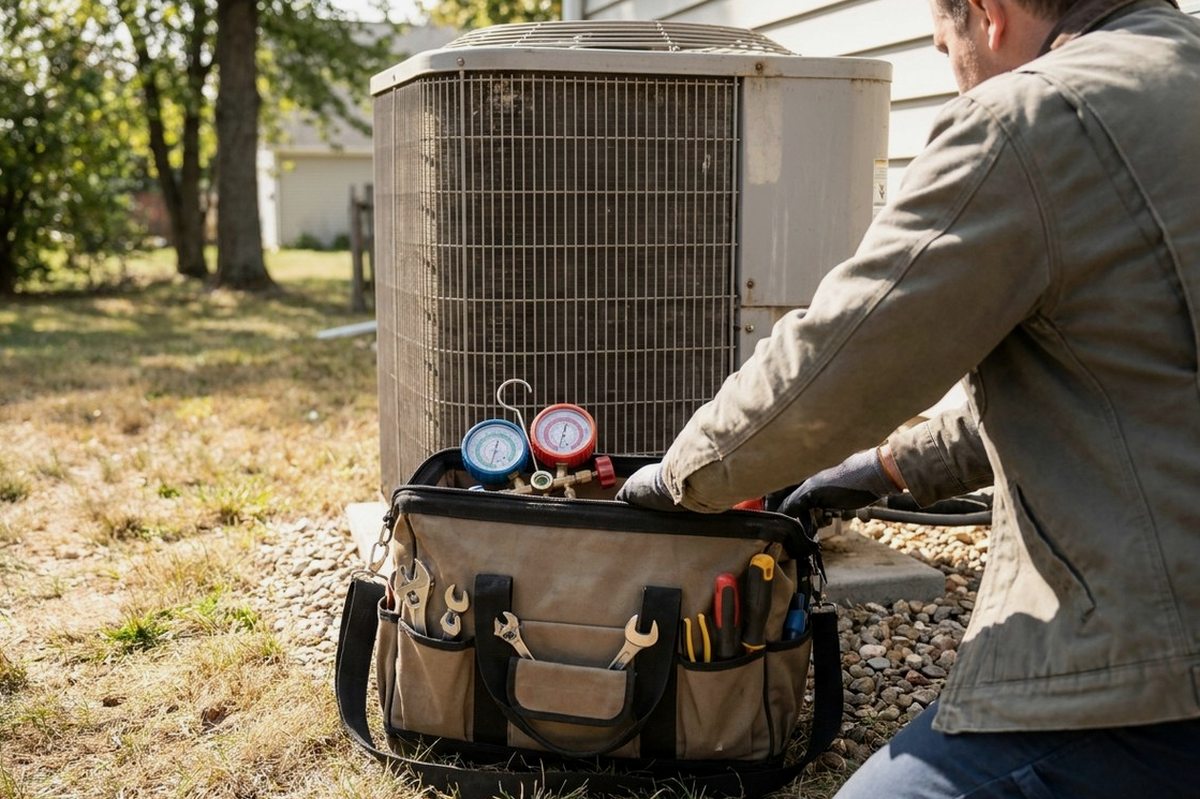
Ozark Comfort Heating & Air service team · field-reviewed before publishing
What the Noise Is Actually Telling You
Every sound points somewhere different. A steady buzz or hum usually means something electrical is energized but struggling, like a contactor or a motor trying to start. A rattle is almost always mechanical, from loose panels, bad fan blade balance, or gravel and sticks in the cabinet. A screech or squeal points at a bearing or a belt-driven part on older equipment. A hard bang or clank at shutdown is different again and needs to be looked at soon. Note when the noise happens, at startup, all the way through the cycle, or only when the fan spins down. That timing saves us guessing time on a long hill-country drive.
The Cheap Causes First: Debris and Loose Hardware
Most rattles we chase turn out to be simple. Screws back out of the service panels over a few seasons and the sheet metal drums against the frame. Cottonwood fluff, leaves, mulch and small stones get pulled against the coil or drop past the fan grille. Yard equipment throws pebbles into the cabinet. A fan blade with a nicked tip goes out of balance and shakes the whole unit. Anything mounted on a pad that has settled or heaved will hum against the concrete. These are the fixes that take minutes once someone is standing there, and they are worth ruling out before anyone talks about parts.
Electrical Buzz and Failing Motors
A loud buzz on startup often traces to the contactor, the relay that pulls in the compressor and fan. Contact points pit and chatter, and you hear it. A weak start capacitor makes the compressor grunt and hum without turning, sometimes tripping the breaker. Fan motors develop dry bearings and give you the screech. Compressor bearings can do the same on older heat pumps, and that is a bigger conversation. None of this is homeowner territory. Capacitors hold a charge after power is off and the wiring at the disconnect is high voltage. Turn the system off and let us open the cabinet.
What You Can Safely Check Yourself
Stick to the outside of the equipment and the thermostat. Check that the thermostat is set the way you expect and swap the batteries if it has them. Look at your breaker panel for a tripped breaker, and if it trips again leave it off and call. Change a dirty filter, since a starved system works harder and gets louder indoors. Clear leaves, grass clippings and weeds back about two feet around the outdoor unit and pull anything off the top grille. Walk the house and confirm supply and return vents are open. That is the whole safe list. Do not remove panels, touch refrigerant lines, or poke at wiring.
What a Technician Does Differently
We show up with meters and a plan. We pull amp draw on the compressor and fan motor to see whether a part is working hard or barely working. We test capacitor microfarads against the rating on the label, check contactor points, and read voltage at the disconnect. We spin the fan by hand with power off to feel bearing wear, and check blade balance. Refrigerant pressures tell us whether the compressor is loaded correctly or fighting a restriction. Then you get a straight answer on whether it is a small part, a motor, or an aging system worth planning around. Since our routes run long, we bring common parts with us so most noise calls end the same visit.
When it is time to book
Buzzing, Rattling, or Screeching From the Outdoor Unit — what people ask
Can I keep running the AC if it is buzzing?
If the buzz is quiet and the house is still cooling, running it a short while is usually fine. If it is loud, the unit is not cooling, or the breaker trips, shut it off at the thermostat and call for air conditioner repair.
Why does it only screech when it first starts?
Startup screech usually points at a bearing that is dry or a motor straining to come up to speed. It rarely gets better on its own. Catching it early often means replacing one motor instead of chasing damage further into the system.
Is a loud outdoor unit dangerous?
The noise itself is not, but the cause can be. Electrical chatter and locked compressors draw heavy current and can trip breakers or overheat wiring. Turn the system off, keep hands out of the cabinet, and let us test it.
How it works
- Step 1
Tell us the symptom
Call or fill in the quote form with what the system is doing. Warm air, no air, short cycling, a smell, a breaker that keeps tripping. That detail helps us load the right parts before we roll.
- Step 2
We schedule around travel
Hill-country routes take time, so we give you a realistic window instead of a guess. If you are on a long county road, we tell you that up front and keep you posted if the day shifts.
- Step 3
Diagnose, then explain
We test the system, find the actual fault and walk you through what failed and what the repair involves. You decide before we start. If a part has to be ordered, we say when it lands.
- A real person answers
- Open 7 days
- Written quote before work starts
Why homeowners call us
- Older systems are normal herePlenty of homes on our routes run a heat pump from two decades back, a propane furnace and a wood stove for the cold snaps. We repair what you have rather than pushing you toward replacement on the first visit.
- Heating and cooling bothSame crew handles air conditioning repair in summer and heating repair in winter. That means we know your system's history when the season flips, and we are not learning your ductwork from scratch in January.
- We say what we do not knowIf a fault is intermittent, we tell you that instead of replacing parts on a hunch. Sometimes the honest answer is a monitoring period or a second visit when the weather brings the problem back.
- Regional coverage, local paceWe cover Arkansas, Missouri, Mississippi, Oklahoma and Tennessee. Travel time is part of every job we quote, so you get a window that accounts for the drive rather than a promise that falls apart.
- All major brands, gas & electricEvery major HVAC brand, gas and electric, handled by an independent crew.
- Straight answersNot worth fixing? We say that out loud, and often it saves you the visit fee.
About this guide
Past the safe checks, it's a job for tools and a meter
Tell us what you tried and what it did. The booking itself takes a minute.
- A real person answers
- Open 7 days
- Written quotes
- All major brands
- Gas & electric
Rather not call? Get a free quote →