
Homeowners' pick for heating and cooling across the Arkansas Ozarks and Little Red River country
Keeping the Condensate Drain Clear
Water is dripping from the ceiling under your air handler, or the AC shut itself off on a hot afternoon and you cannot figure out why. Nine times out of ten that comes back to the condensate line. We handle condensate clogs, water damage from overflow and drain pan problems on cooling systems across Arkansas, Missouri, Mississippi, Oklahoma and Tennessee. Here is what that line does and how to keep it clear.
Call (888) 381-2953- A real person answers
- Open 7 days
- Written quote before work starts
Taking calls until 5:00 PM CT
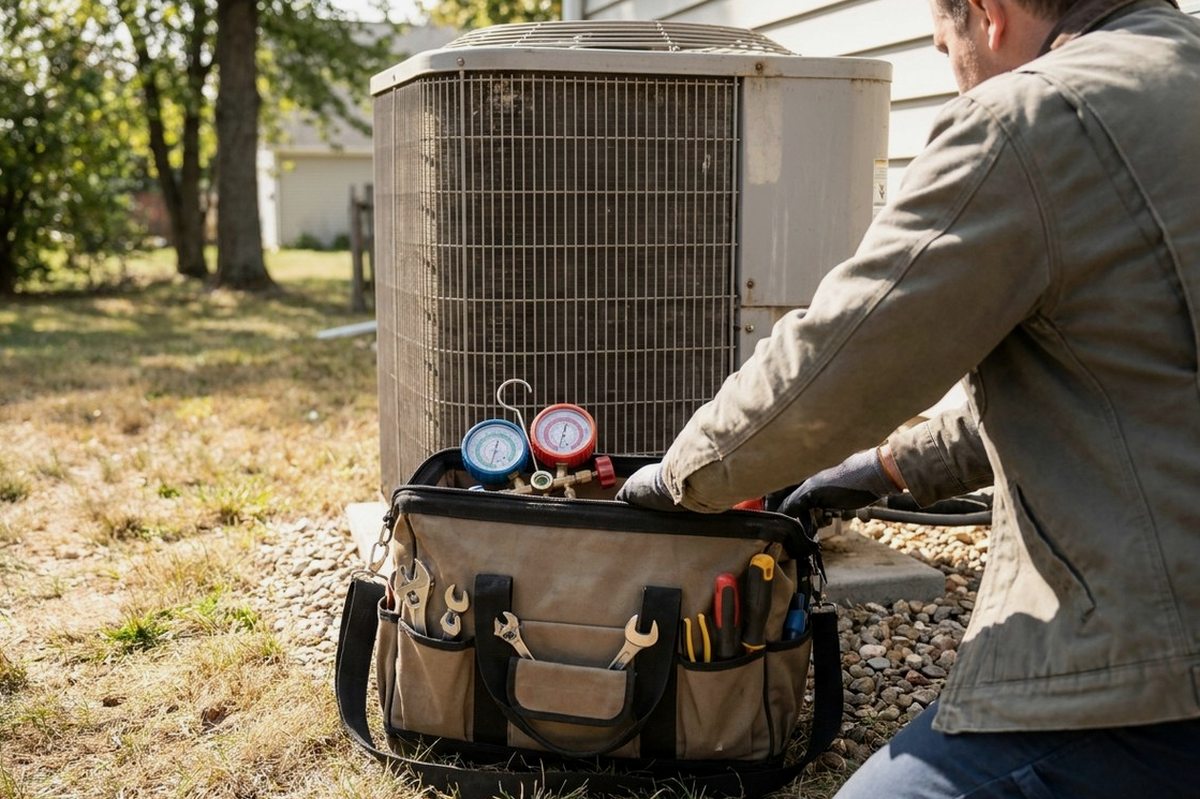
Ozark Comfort Heating & Air service team · field-reviewed before publishing
What the condensate line actually does
When your AC runs, warm indoor air passes over a cold coil and the moisture in that air condenses, the same way a glass of ice water sweats in July. On a humid day a system can pull gallons of water out of your house. All of it collects in a drain pan under the coil and leaves through a small plastic pipe, usually running out a wall, into a floor drain, or into a pump that lifts it up and out. That pipe is often three quarters of an inch wide. It does not take much to plug it.
What neglect looks like over a few seasons
Clogs do not start as clogs. Dust that slips past the filter mixes with condensation and grows a slimy film inside the pipe. Algae takes hold. The passage narrows, water backs up into the pan, and then the pan overflows. In attic installations that water finds the drywall below and you get a brown ring on the ceiling before you get a phone call. In closets and basements it soaks subfloor and insulation. Systems with a safety float switch shut the cooling off instead, which is better, though it means no AC on the hottest week of the year. Over longer stretches, standing water rusts pans and feeds mold near the coil, which shows up as a musty smell every time the blower starts.
The simple habit that prevents most of it
Two things do most of the work. First, change your filter on schedule, because less dust in the air means less sludge in the drain. Second, look at where the line ends. On a hot humid day with the AC running, water should be trickling out steadily. No water during a muggy stretch means the line is not draining, even if nothing has overflowed yet. Also keep the area around your outdoor unit clear of leaves and grass clippings so the whole system is not working harder than it needs to. If your setup uses a condensate pump, listen for it cycling. A pump that never runs or never stops is telling you something.
How often to check, and when to have us out
Walk out and check that drain once a month through cooling season, and glance at your filter at the same time. Most homes want a fresh filter every one to three months depending on pets, dust and how much the system runs. Once a year, before the first real hot spell, have the drain line and pan cleaned properly as part of a cooling tune up. That is when we clear the line, flush the trap, test the float switch and check the pan for rust. Older heat pumps that run in both seasons put more hours on the drain than a cooling only system, so annual attention matters more on those.
Warning signs it is already too late
Call us if you see water stains on a ceiling or wall near the air handler, standing water in the drain pan, or wet insulation around the unit. A musty smell that appears when the blower kicks on points to moisture sitting where it should not. If your AC runs a while and then quits, and the thermostat looks fine, a float switch may have tripped on a full pan. You can check thermostat settings and batteries, look for a tripped breaker and change the filter. Beyond that, leave it to us so we can find whether the clog is in the trap, the line or the pump before more water gets into the house.
When it is time to book
Keeping the Condensate Drain Clear — what people ask
Can I pour bleach down the condensate line myself?
We would rather you did not guess. Bleach can damage some pans and fittings, and pouring anything into the wrong opening makes a mess. Have the line flushed and cleaned during an annual cooling visit instead.
Why is water coming out of my AC only on humid days?
More humidity means more condensation, so a partly blocked line that keeps up on a dry day overflows on a muggy one. It is an early warning that the drain needs clearing before it plugs completely.
My AC keeps shutting off but the thermostat is fine. Is it the drain?
Often, yes. Many systems have a float switch that cuts cooling when the drain pan fills, protecting your ceiling. Check for a tripped breaker and a dirty filter, then call us to trace the blockage.
How it works
- Step 1
Tell us the symptom
Call or fill in the quote form with what the system is doing. Warm air, no air, short cycling, a smell, a breaker that keeps tripping. That detail helps us load the right parts before we roll.
- Step 2
We schedule around travel
Hill-country routes take time, so we give you a realistic window instead of a guess. If you are on a long county road, we tell you that up front and keep you posted if the day shifts.
- Step 3
Diagnose, then explain
We test the system, find the actual fault and walk you through what failed and what the repair involves. You decide before we start. If a part has to be ordered, we say when it lands.
- A real person answers
- Open 7 days
- Written quote before work starts
Why homeowners call us
- Older systems are normal herePlenty of homes on our routes run a heat pump from two decades back, a propane furnace and a wood stove for the cold snaps. We repair what you have rather than pushing you toward replacement on the first visit.
- Heating and cooling bothSame crew handles air conditioning repair in summer and heating repair in winter. That means we know your system's history when the season flips, and we are not learning your ductwork from scratch in January.
- We say what we do not knowIf a fault is intermittent, we tell you that instead of replacing parts on a hunch. Sometimes the honest answer is a monitoring period or a second visit when the weather brings the problem back.
- Regional coverage, local paceWe cover Arkansas, Missouri, Mississippi, Oklahoma and Tennessee. Travel time is part of every job we quote, so you get a window that accounts for the drive rather than a promise that falls apart.
- All major brands, gas & electricEvery major HVAC brand, gas and electric, handled by an independent crew.
- Straight answersNot worth fixing? We say that out loud, and often it saves you the visit fee.
About this guide
Safe checks done and it still misbehaves? That's a real fault
Tell us what you tried and what it did. The booking itself takes a minute.
- A real person answers
- Open 7 days
- Written quotes
- All major brands
- Gas & electric
Rather not call? Get a free quote →