
Homeowners' pick for heating and cooling across the Arkansas Ozarks and Little Red River country
How Often a Filter Actually Needs Changing
You bought a filter, wrote the date on it with a marker, and then a year went by. Now the air handler runs longer than it used to and the vents feel weak. Changing a filter is the cheapest thing you can do for your heating and cooling system, and it is the thing most homeowners forget. Here is what actually happens when it goes too long, and how often to swap it.
Call (888) 381-2953- A real person answers
- Open 7 days
- Written quote before work starts
Taking calls until 5:00 PM CT
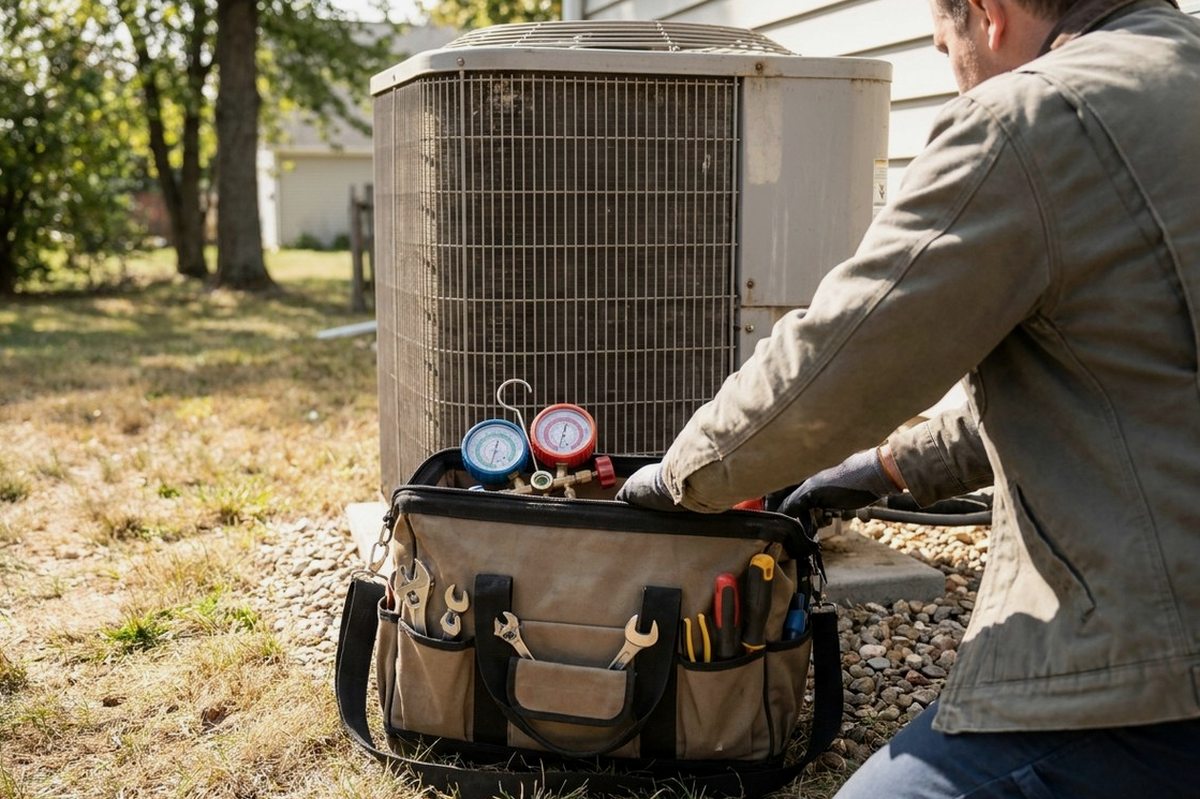
Ozark Comfort Heating & Air service team · field-reviewed before publishing
What a Dirty Filter Does Over Months, Not Days
A loaded filter starves the blower for air. The blower keeps spinning at the same speed but moves less air, so in summer the indoor coil gets too cold and can ice over, and in winter the heat exchanger runs hotter than it was designed to run. Neither problem shows up the first week. Over a season you get longer run times, rooms that never quite catch up, and a compressor or blower motor working under strain. We have opened up plenty of systems across Arkansas, Missouri, Mississippi, Oklahoma and Tennessee where the only real fault was a filter nobody had touched in two years.
The Habit That Prevents Almost All of It
Pick a date you already remember and tie the filter to it. The first of the month, the day you pay a bill, whatever sticks. Buy filters four or six at a time and keep them stacked near the return grille so there is no trip to town standing between you and a five minute job. Write the install date on the cardboard edge with a marker. When you pull the old one, hold it up to a light. If you cannot see light through it, you waited too long and the next one should come sooner. That one note tells you your real schedule better than any label on the box.
How Often, Realistically
A one inch filter in a house with people and pets usually wants changing every 30 to 60 days during heavy heating or cooling months. Thicker media filters, the four and five inch cabinets, often go six months to a year, but they still need checking. Country roads, gravel drives, wood heat and dogs all shorten the interval. So does running the fan continuously. If you are on a well travelled dirt road or you burn wood as backup, plan on monthly checks and be ready to change more often than the packaging suggests. Empty houses and mild shoulder seasons stretch it out. Look, do not guess.
Warning Signs You Are Already Past Due
Weak airflow at the vents is the first one. Then the system runs longer for the same comfort, and the room farthest from the air handler stops keeping up. Ice on the refrigerant lines or the indoor coil in cooling season, a musty smell when the blower starts, or a furnace that heats then shuts off early and restarts are all signs the system is choking. Dust settling on furniture faster than it used to counts too. Change the filter, make sure your supply vents are open, and give it a day. If the symptoms stay, call us and we will look at the coil, the blower and the airflow itself.
When a Filter Change Is Not the Answer
If a fresh filter does not fix it, the problem is downstream. A coil that has been fed dirty air for years grows a mat of dust on the fins that no filter change will undo, and that needs cleaning by hand. Blower wheels load up the same way. Undersized or crushed return ducts create the same starved airflow symptoms with a clean filter in place. Those are things we check on a service call, along with refrigerant charge and temperature split. If you smell gas or a carbon monoxide alarm sounds, leave the building first, then call 911 or your gas utility, then call us. Do not stay inside troubleshooting.
How Often a Filter Actually Needs Changing — what people ask
Does a more expensive filter help or hurt?
Both, depending on your ductwork. Denser filters catch more but restrict more air. If your return is small or your ducts are tight, a high resistance filter can starve the blower. Ask us what your system can handle.
Can I run without a filter for a few days?
Better than running a clogged one, but not for long. Everything the filter would have caught goes straight onto the indoor coil and blower wheel, and cleaning those costs far more than a filter. Put a new one in.
Which way does the arrow point?
The arrow points in the direction of airflow, toward the air handler or furnace and away from the return grille. Installed backward, the filter loses efficiency and can collapse into the blower over time.
How it works
- Step 1
Tell us the symptom
Call or fill in the quote form with what the system is doing. Warm air, no air, short cycling, a smell, a breaker that keeps tripping. That detail helps us load the right parts before we roll.
- Step 2
We schedule around travel
Hill-country routes take time, so we give you a realistic window instead of a guess. If you are on a long county road, we tell you that up front and keep you posted if the day shifts.
- Step 3
Diagnose, then explain
We test the system, find the actual fault and walk you through what failed and what the repair involves. You decide before we start. If a part has to be ordered, we say when it lands.
- A real person answers
- Open 7 days
- Written quote before work starts
Why homeowners call us
- Older systems are normal herePlenty of homes on our routes run a heat pump from two decades back, a propane furnace and a wood stove for the cold snaps. We repair what you have rather than pushing you toward replacement on the first visit.
- Heating and cooling bothSame crew handles air conditioning repair in summer and heating repair in winter. That means we know your system's history when the season flips, and we are not learning your ductwork from scratch in January.
- We say what we do not knowIf a fault is intermittent, we tell you that instead of replacing parts on a hunch. Sometimes the honest answer is a monitoring period or a second visit when the weather brings the problem back.
- Regional coverage, local paceWe cover Arkansas, Missouri, Mississippi, Oklahoma and Tennessee. Travel time is part of every job we quote, so you get a window that accounts for the drive rather than a promise that falls apart.
- All major brands, gas & electricEvery major HVAC brand, gas and electric, handled by an independent crew.
- Straight answersNot worth fixing? We say that out loud, and often it saves you the visit fee.
About this guide
Safe checks done and it still misbehaves? That's a real fault
Report what you saw during the checks and we handle the rest. A minute to book.
- A real person answers
- Open 7 days
- Written quotes
- All major brands
- Gas & electric
Rather not call? Get a free quote →